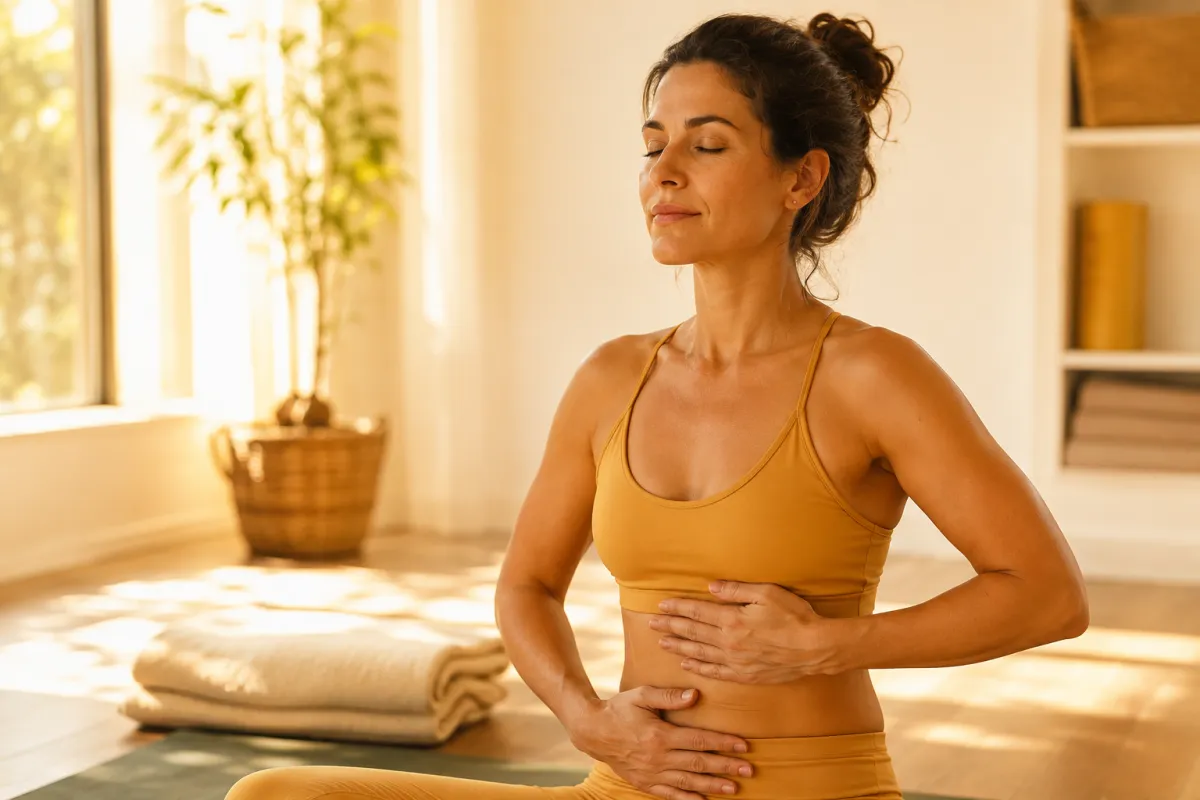
The Third Chakra: Breathing, Core Support, Confidence, and Personal Power
The third chakra is traditionally associated with confidence, motivation, inner strength, and personal power.
It is also connected with the element of fire and is sometimes called Manipura, meaning “city of jewels.”
But what does that have to do with the physical body?
At Balance Yoga, the chakras provide an organized framework for exploring the relationships between anatomy, movement, breathing, the nervous system, and human experience.
The third chakra gives us a particularly interesting place to begin because its traditional location overlaps with a significant anatomical area of the body.
Where Is the Third Chakra?
The third chakra is associated with the area above the navel and below the ribs.
This region includes the diaphragm, abdominal muscles, digestive organs, lower ribs, and an extensive network of autonomic nerves called the celiac plexus.
The celiac plexus is also commonly called the solar plexus. It helps carry information between the nervous system and many of the abdominal organs, including the stomach, liver, pancreas, spleen, kidneys, and portions of the intestines. NCBI: Celiac Plexus Anatomy
This does not prove that the third chakra is a physical structure or that confidence is stored in the abdomen. It does show that this traditional chakra location corresponds with an anatomically active region involved in breathing, digestion, pressure management, and autonomic nervous system function.
Why Do We Feel Emotions in the Abdomen?
You may have experienced “butterflies” before doing something exciting, tightness in your stomach during a stressful situation, or a sinking sensation when something feels wrong.
These sensations are real, even though confidence and fear are not physically stored inside the abdomen.
The brain, nervous system, breath, muscles, and internal organs continually communicate. Emotional stress may affect breathing, digestion, posture, muscular tension, and heart rate. Physical sensations can also influence how safe, calm, or prepared we feel.
This is why telling someone to “just relax” is rarely enough. Sometimes the body needs an experience of support, movement, and easier breathing before the nervous system is ready to settle.
The Diaphragm Is More Than a Breathing Muscle
The diaphragm sits beneath the lungs and separates the chest from the abdominal cavity.
As we inhale, the diaphragm contracts and moves downward. The lower ribs widen, the abdominal contents shift, and pressure inside the abdomen changes. During exhalation, the diaphragm releases upward.
The diaphragm also works with the abdominal muscles and other trunk muscles to help manage pressure and support the spine. Research has demonstrated coordinated activity between the diaphragm and abdominal muscles during postural tasks. PubMed: Diaphragm and Abdominal Muscle Coordination
This is one reason breathing cannot be separated completely from posture or core support.
Core Support Does Not Mean Holding Your Stomach Tight
Many people believe that using the core means pulling the stomach inward and holding it there.
But constant gripping can restrict breathing, limit rib movement, and create unnecessary pressure.
The core is not one muscle. It is a coordinated system that includes the diaphragm, abdominal wall, spinal muscles, and pelvic floor. These muscles need to respond to the activity you are performing.
Lifting something heavy requires more support than sitting quietly. Standing on one leg requires different coordination than lying on the floor.
Useful core support is adaptable. It can create stability when needed and release when the work is finished.
During yoga, we can practice noticing:
Whether the breath continues during effort
Whether the abdomen is gripping unnecessarily
How the ribs move during inhalation and exhalation
Whether the spine is supported without becoming rigid
How much effort a movement actually requires
Whether tension remains after the movement is over
The goal is not to keep the core contracted throughout the entire class. The goal is to use the appropriate amount of support at the appropriate time.
What Does This Have to Do With Confidence?
Traditional chakra teachings associate the third chakra with confidence, determination, self-respect, and the ability to act.
Science does not tell us that confidence lives in the solar plexus. However, the way we breathe, stand, and move can influence how we experience ourselves.
When someone feels uncertain, they may hold their breath, collapse through the chest, tighten the abdomen, or make themselves physically smaller. When someone feels prepared and supported, their breathing and posture may change.
This does not mean that changing your posture instantly fixes fear or low self-confidence. It means the relationship between body and mind moves in both directions.
A physical practice can give us an opportunity to experience steadiness, make choices, tolerate appropriate challenges, and notice our own capabilities.
Confidence is not always loud or dramatic.
Sometimes confidence is taking one steady breath.
Sometimes it is choosing a smaller movement because that is what your body needs.
Sometimes it is trying something new.
Sometimes it is saying no.
Sometimes it is allowing yourself to take up space.
Exploring the Third Chakra Through Yoga
A third chakra-focused yoga practice may include:
Diaphragmatic breathing
Gentle rib and spinal movement
Side-body opening
Twisting without forcing
Balanced abdominal support
Hip and leg strength
Postures that encourage an upright, spacious position
Restorative poses that reduce unnecessary gripping
Opportunities to make choices and trust the body’s feedback
The movements themselves are not magical. Their value comes from the attention, coordination, and awareness we bring to them.
At Balance Yoga, depth is not the goal. Movement quality and control matter more.
Chakra-Focused Yoga at Balance Yoga
Our Thursday classes at 4:00 and 5:30 PM use the chakras as themes for exploring the body, breath, nervous system, and self-awareness.
You do not need to follow a particular religion, adopt a spiritual belief, or understand the chakras before attending. My teaching remains grounded in anatomy, thoughtful movement, and science-backed yoga practices.
If you are curious about chakra-focused yoga but want an approach that makes sense in your body, you are welcome to join us.
Balance Yoga
Springfield, Illinois


