Welcome to Squat-tober!
Squat-tober: The Movement We Stopped Using
When was the last time you squatted all the way down?
Not a gym squat with weights.
Not lowering yourself onto a chair.
I mean really squatted. Hips low. Knees bent. Feet on the floor.
For many adults, the answer might be: I have no idea.
And that is part of the problem.
We Used to Squat Because Life Required It
Squatting is not some fancy yoga pose or exercise invented at the gym.
It is a basic human movement.
Around the world, people still squat as part of everyday life: to work near the ground, prepare food, rest, perform certain religious practices and, in many places, use the toilet.
Research looking at deep squatting describes it as a common daily activity in many non-Western populations, including for household tasks, bathing, socializing and toileting.
Here in the United States, we have designed much of that movement out of our lives.
We sit in chairs.
We sit on couches.
We sit in cars.
We use elevated toilets.
We bend over to pick something up instead of lowering ourselves toward the ground.
And gradually, many adults simply stop squatting.
Squatting Is a Use-It-or-Lose-It Movement
A deep squat asks quite a bit of the body.
Your hips have to flex.
Your knees have to bend.
Your ankles need enough dorsiflexion to allow the lower leg to move forward while the foot remains grounded.
Your feet, legs and trunk have to organize themselves to keep you balanced.
Research examining deep squatting confirms that hip, knee and ankle range of motion all contribute to the ability to squat deeply. Studies also show that older adults tend to squat less deeply and use different movement strategies than younger adults.
That does not mean everyone needs to be able to sit comfortably in a full squat for ten minutes.
It does mean that when we completely stop asking our joints to move into certain ranges, we should not be terribly surprised when those ranges become harder to access.
Movement is a skill. Skills need practice.
Does Squatting Prevent Hip Replacements?
This is where I want to be careful.
It would be easy to look at cultures where squatting remains common and conclude that squatting protects people from hip problems.
The research is not that simple.
Hip osteoarthritis does vary substantially around the world. A large systematic review found lower pooled prevalence in Africa and Asia and higher prevalence in North America and Europe. But that does not prove that squatting is the reason for those differences. Age, genetics, body weight, occupation, healthcare access, diagnosis and many other factors can influence those numbers.
And more is not always better.
Research has also associated prolonged daily squatting, particularly hours of repetitive or occupational squatting, with increased knee osteoarthritis in some populations.
So my message is not:
Everybody needs to spend hours every day in a deep squat.
My message is:
Maybe we should stop allowing this movement to disappear completely.
There is a lot of space between never squatting and squatting for hours.
That middle ground is where I want us to play during Squat-tober.
You Do Not Need Another Workout
This may be my favorite part.
You don't necessarily need to add a 30-minute squat practice to your day.
Instead, start putting movement back into the life you are already living.
There is a concept called habit stacking that James Clear writes about in Atomic Habits. The idea is simple: attach a new habit to something you already do regularly.
So instead of saying:
“I need to remember to work on my hips today.”
Connect hip movement to something that already happens.
Waiting for the Coffee?
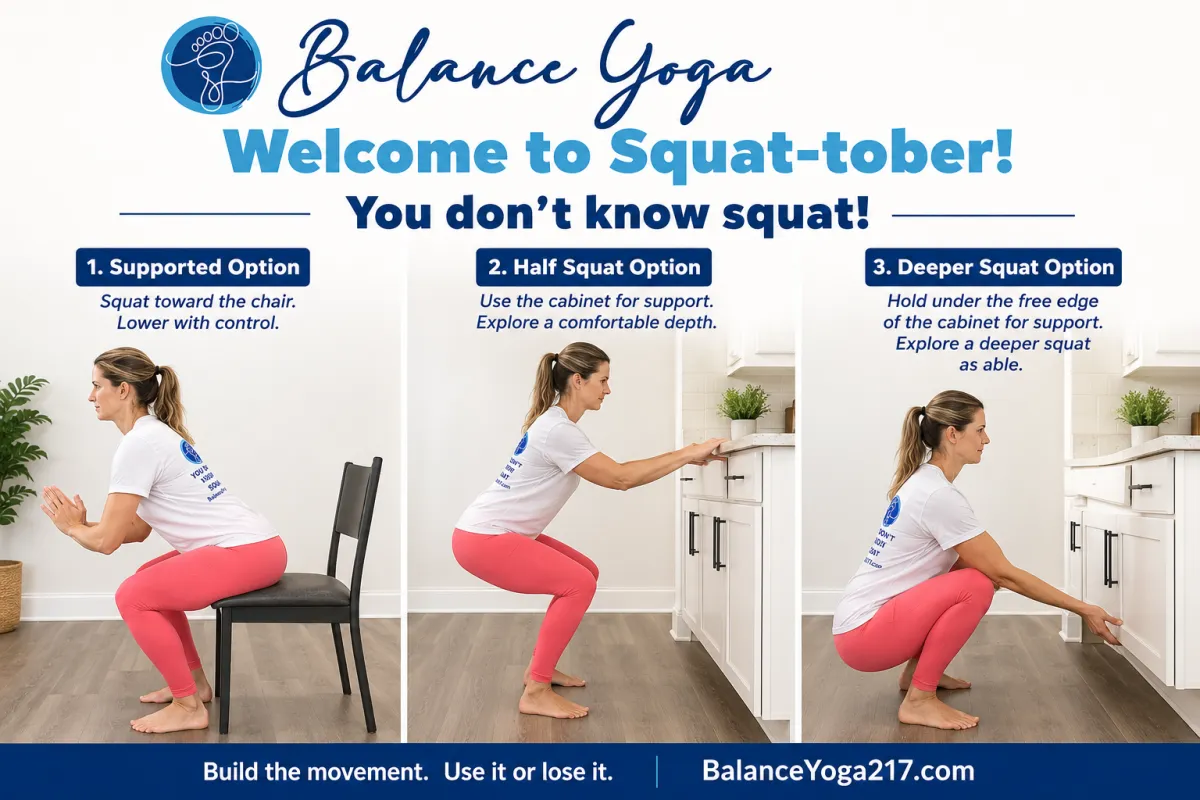
Use the kitchen counter for support and explore a comfortable squat.
It doesn't have to be deep.
Maybe today you lower just a few inches.
Maybe you squat toward a chair.
If you are able to squat more deeply, try holding onto the underside edge of your kitchen cabinetry near the kickplate to help support and control your descent into a deeper squat.
Let the cabinet assist you instead of forcing your body to hold the entire position on its own.
Meet your body where it is.
Brushing Your Teeth?
Your bathroom can become another easy place to practice.
Explore a few small, supported squats while you brush.
If a deeper squat is appropriate for you, hold onto the underside edge of the bathroom cabinetry and use it to assist you as you lower and rise.
Your toothbrush already reminds you to take care of your teeth. Let it become a reminder to give your hips some movement too.
Waiting for the Microwave?
You have 30 seconds, a minute, maybe two.
That's movement time.
Squat toward a chair.
Hold the counter or the underside edge of the cabinetry and explore your hips.
Rise onto your toes.
Move your ankles.
The microwave beep becomes your finish line.
Watching Television?
Commercials used to be perfect movement reminders.
If you stream everything now, choose another cue: the end of an episode, when the credits start, or anytime you hit pause.
Get up.
Move your hips.
Try a supported squat.
Sit on the floor and get back up.
The goal is not exercise punishment.
The goal is to keep reminding your body:
We still move this way.
What About a Squatty Potty?
Yes, even your bathroom can become part of the conversation.
A toilet footstool, commonly known by the brand name Squatty Potty, elevates the feet while you are sitting on a Western-style toilet.
That does not put you into a true deep squat, but it changes the position of the hips and knees and creates a posture closer to squatting.
Research on toileting posture suggests that squatting or squat-like positions can change the anorectal angle and may make bowel evacuation easier or reduce straining for some people. A recent review of 42 studies found potential digestive advantages to squatting compared with conventional sitting, although the evidence is not perfect and sitting toilets may be more appropriate for some people.
So yes, even putting your feet on a bathroom stool can introduce your hips to a different position they may rarely experience during the rest of the day.
Your Squat Does Not Have to Look Like Mine
This is important.
A squat is influenced by your ankle mobility, hip mobility, leg and torso proportions, strength, previous injuries and the structure of your individual body.
Your heels may not touch the floor.
Your feet may need to turn out.
You may need to hold onto something.
You may only lower halfway.
You may need a chair behind you.
That does not mean you are “bad at squatting.”
It means we figure out where your squat is today and work from there.
At Balance Yoga, I am much more interested in helping you create usable movement than forcing your body into a picture-perfect position.
Welcome to Squat-tober
So this October, I have a challenge for you.
Don't just squat when someone tells you to during yoga class.
Put squatting and hip movement back into your life.
While the coffee brews.
While you brush your teeth.
While you wait for the microwave.
While you watch television.
While you pick something up.
When you get down on the floor.
Maybe even when you go to the bathroom.
Start small. Use support. Pay attention to what your body tells you.
Because the movement you want to have ten or twenty years from now needs somewhere to live today.
This month at Balance Yoga, we're calling it Squat-tober.
Let's use the movement before we lose the movement.


