What Is a Yoga Wall? How Support Can Change the Way You MoveNew Blog Post
What Is a Yoga Wall? How Support Can Change the Way You Move
When people first see the Great Yoga Wall at Balance Yoga, they often assume it is only for advanced students or people who want to hang upside down.
It isn’t.
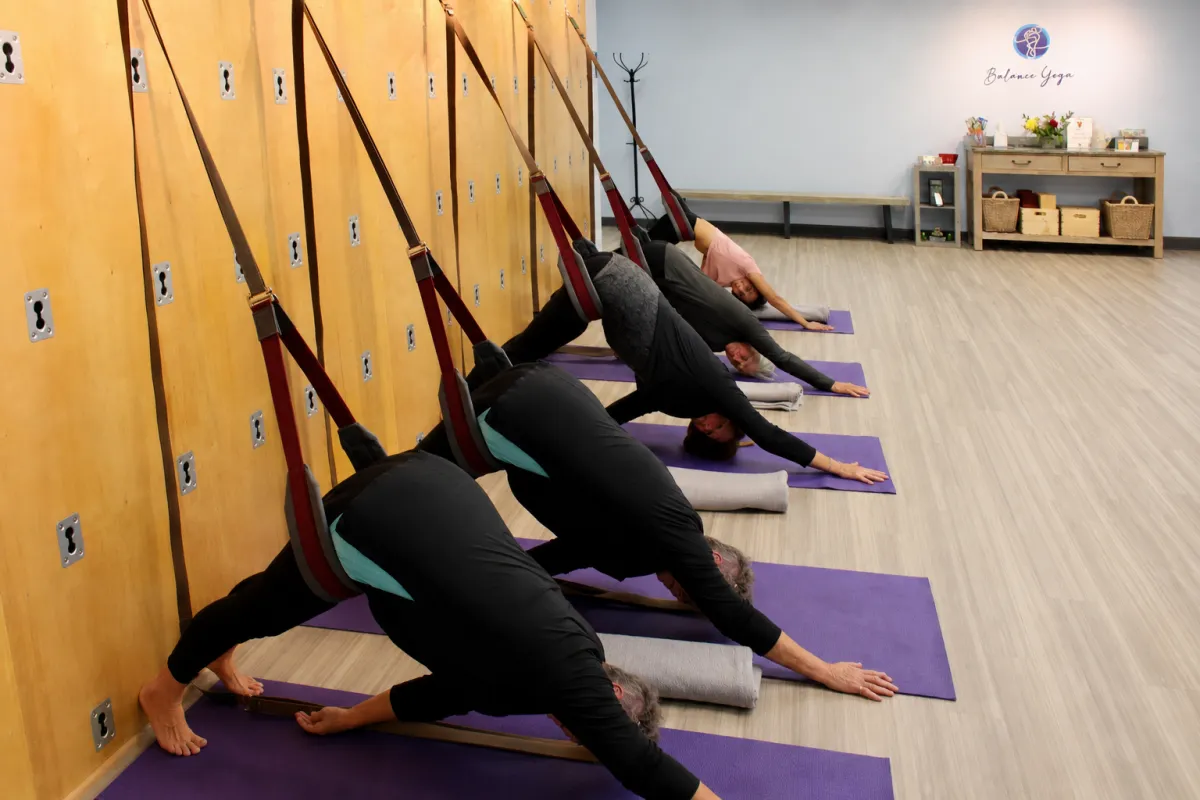
The Yoga Wall itself almost looks like it could be a piece of art rather than a yoga prop or tool for healing. Nearby, adjustable Wall belts, pelvic swings, bars and other attachments are neatly stored and used with the secure wall system.
Depending on how it is used, the Yoga Wall can provide support, resistance, feedback, stability and traction.
It can make familiar yoga poses feel completely different. More importantly, it can help students better understand what their bodies are doing within those poses.
At Balance Yoga in Springfield, Illinois, we do not use the Yoga Wall to make movement look impressive. We use it to make movement feel better, work better and support daily life.
The Yoga Wall Is a Teaching Tool
One of the most valuable things about the Yoga Wall is the feedback it provides.
In a traditional yoga pose, you may not realize that you are shifting more weight into one foot, rotating one hip, collapsing or arching through your ribs, or using tension to hold yourself in position.
The support of the Yoga Wall can make these patterns easier to feel.
A pelvic swing or Wall belt around the hips might help you notice how your pelvis is moving. Holding a Wall belt can provide enough stability for you to explore a movement without worrying as much about balance. Support from the Wall may also allow you to experience spinal length without using unnecessary tension through the shoulders, head or neck.
Hanging Dog is one of my favorite examples.
In a traditional Downward Facing Dog, many students dump weight into the shoulders and ribs while holding unnecessary strain through the head and neck.
Hanging Dog changes that relationship with gravity.
The Wall allows us to explore traction and axial spinal extension, creating length through the spine instead of adding more compression.
This gives us an opportunity to follow the same process I use throughout my teaching:
Observe. Understand. Adjust.
The Yoga Wall does not do the work for you. It gives you information and support so you can work with your body more intentionally.
Support Does Not Mean Easy
People sometimes assume that using support makes yoga less effective.
In reality, the right support can help you work more accurately.
When your body feels unstable or uncertain, it may respond by gripping, holding the breath, limiting movement or finding another way to compensate.
Once you feel supported, you may be able to release unnecessary tension and pay closer attention to how you are actually moving.
The Yoga Wall can also add resistance. Depending on the position, students may use Wall belts, bars or other equipment to build strength, improve control or practice maintaining alignment while the body is moving.
Sometimes the Yoga Wall makes a pose more accessible.
Sometimes it makes the work more challenging.
Sometimes it makes the work more precise.
It all depends on how we use it.
What Does the Yoga Wall Feel Like?
There is no single Yoga Wall experience.
Some movements feel grounding and stable. Others create an incredible sense of length or space.
For some students, traction becomes the miracle movement they did not know they were missing.
A body that has spent years feeling compressed can respond very differently when it finally experiences space and length.
A supported position may allow the back body to soften, the ribs to move more freely or the shoulders to release unnecessary effort.
The Yoga Wall may be used to explore:
Balance and stability
Strength and controlled movement
Postural awareness
Hip and shoulder mobility
Spinal length and organization
Axial spinal extension
Supported standing poses
Traction
Restorative positions
Breath awareness
Body awareness and alignment
Each student’s experience will be different because each body arrives with different proportions, movement habits, strengths, restrictions and needs.
That is why simply copying the person next to you is rarely the goal at Balance Yoga.
We adjust the Wall belts, props, position and movement to fit the person using them.
Is the Yoga Wall Only for Flexible or Experienced Students?
No.
Beginners often benefit tremendously from the Yoga Wall.
You do not need to be flexible, strong or experienced before trying it.
In fact, the Yoga Wall may help you understand a pose more clearly because you receive feedback that can be difficult to find when practicing in the middle of an open room.
The support can also make it easier to slow down.
Instead of concentrating only on holding yourself in position, you can begin noticing where you feel pressure, where you are gripping, how you are breathing and whether both sides of your body are participating equally.
Experienced yoga students can benefit too.
The Yoga Wall may reveal movement patterns that have gone unnoticed for years or offer an entirely new way to explore familiar poses.
Do You Have to Go Upside Down?
Absolutely not.
The Yoga Wall can be used while standing, sitting, kneeling, supine or lying on your back, and in many other supported positions.
Inversions are only one small part of what the system can offer, and they are not appropriate for everyone.
Students with certain health conditions or other concerns may need to modify or avoid inverted positions. Even when an inversion is appropriate, it is introduced thoughtfully.
No one is required to go upside down.
There are many ways to experience the Yoga Wall while remaining upright or close to the floor.
How Is Restorative Yoga on the Wall Different?
During a restorative Yoga Wall practice, Wall belts and props help support the weight of the body so students can settle into positions with less muscular effort.
Bolsters, blankets and other props may be combined with the Yoga Wall to create comfortable positions for the legs, hips, spine or shoulders.
The goal is not to reach the deepest version of a pose.
The goal is to find enough support that the body can release and become quieter.
A restorative Yoga Wall practice can be especially appealing if you are curious about the Wall but prefer a slower, more supported experience.
Why Balance Yoga Only Has Four Yoga Wall Stations
The Great Yoga Wall at Balance Yoga has four individual stations.
That is intentional.
Keeping Yoga Wall classes small allows me to watch each student carefully.
Wall belt placement, body position, comfort and alignment matter. With only four students, I can help each person adjust the equipment and better understand what is happening in their body.
This is not a class where you are expected to figure everything out by watching someone across the room.
You will receive instruction and support throughout the experience.
Want to Try the Yoga Wall in Springfield, Illinois?
Balance Yoga offers Yoga Wall classes, workshops, specialty series and private sessions throughout the year.
Our current 6-week Level Two Yoga Wall series has already begun. If there is still space available, students may be able to join the series late and have the remaining session price prorated.
Because Balance Yoga has only four Yoga Wall stations, space is always limited.
If you are interested in trying the Great Yoga Wall, check the current schedule or contact Balance Yoga to find out what Yoga Wall opportunities are available now.
And if you are new to yoga, we’re just the studio for you.
Balance Yoga
Springfield, Illinois


