Why Stretching Alone May Not Fix Your Pain
Many people stretch every day and still live with pain.
This is especially common for people dealing with back pain, foot pain, stiffness, or ongoing tension. They stretch the area that feels tight, experience temporary relief, and then notice the same discomfort returning later.
Here’s why stretching alone often isn’t the solution.
Tight Does Not Always Mean Short
When an area feels tight, we naturally assume it needs to be stretched. Sometimes that is true, but tightness can also be the body’s way of creating stability.
A muscle may hold tension because another part of the body is not providing enough support. The area that feels tight may be working harder than it should to help you stand, balance, or move.
Stretching that muscle may feel good temporarily, but it does not necessarily address why the tension developed.
Before deciding that something needs more flexibility, it helps to ask:
Is this area actually short?
Is it weak or overworked?
Is another part of my body failing to provide support?
Am I repeating a movement or posture that keeps creating the same tension?
The location of discomfort is not always the source of the problem.
Strength and Stability Matter
Your body needs both mobility and stability.
Mobility allows you to move through a comfortable range of motion. Stability helps you control that movement and support your joints.
If a joint has plenty of mobility but lacks muscular support, repeatedly stretching it may not help. In some cases, the body may respond by creating even more tension because it does not feel stable.
Building strength around the hips, feet, core, shoulders, or upper back may be more useful than continually stretching the area that feels uncomfortable.
The goal is not simply to become more flexible. The goal is to have enough mobility to move well and enough strength to control that movement.
Your Body May Be Compensating
The body is excellent at finding ways to accomplish a task, even when the intended muscles or joints are not doing their share.
If the hips do not move well, the low back may move more. If the upper back is stiff, the neck or shoulders may work harder. If the feet are not providing a stable foundation, the knees and hips may compensate.
Stretching the place that feels tight does not automatically change the larger movement pattern.
This is why body mechanics matter. We need to look at how the feet, legs, pelvis, spine, ribs, shoulders, and head work together.
A small change in alignment or muscle engagement can sometimes change how an entire movement feels.
Breath and the Nervous System Affect Tension
Not all tension is purely muscular.
Stress, shallow breathing, poor sleep, and feeling rushed can influence how tightly the body holds itself. When the nervous system senses stress or uncertainty, muscles may brace to create a feeling of protection.
Forcing a deeper stretch is not always the best response.
Slow, comfortable movement and steady breathing can help you notice where you are gripping or holding unnecessary tension. Supportive positions and clear movement choices may help the body feel safe enough to soften.
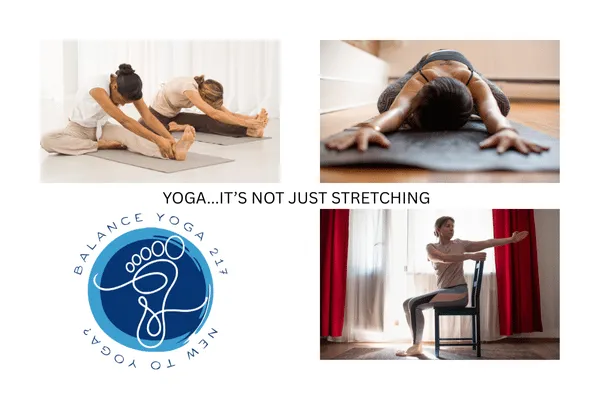
This is one reason yoga is about much more than flexibility.
Yoga Is Not Just Stretching
Let’s bust one of the biggest myths out there:
“Yoga is just stretching.”
Stretching is part of yoga, but yoga offers much more.
Yoga can help develop:
Strength: Building muscles that support your joints, posture, and alignment
Balance: Improving your ability to stay steady and respond to changes
Breath awareness: Recognizing how your breathing affects tension and movement
Focus and awareness: Learning to notice movement habits and compensation patterns
Support: Practicing in a space where you are seen, guided, and encouraged
Yes, you might leave class feeling more flexible. But flexibility alone may not fix pain.
What may help is learning how to move with better alignment, build supportive strength, breathe more efficiently, and understand how your body actually works.
Flexibility becomes one tool, not the entire goal.
Does Stretching Still Have a Place?
Absolutely.
Stretching can feel wonderful and may help maintain or improve mobility. The problem is not stretching itself. The problem is assuming that every sensation of tightness requires a deeper stretch.
Sometimes your body needs mobility. Sometimes it needs strength. Sometimes it needs rest, better positioning, or a different movement strategy.
The most useful approach begins with observation:
Observe what your body is doing. Understand why it may be happening. Adjust the movement based on what you discover.
Learn What Your Body Actually Needs
At Balance Yoga in Springfield, Illinois, we focus on alignment, body mechanics, strength, breath, and real-life movement.
Our beginner-friendly classes are designed for people who want to understand their bodies, not force them into impressive shapes. We use chairs, blocks, straps, the Yoga Wall, and other supportive tools to help students explore movement with more awareness and control.
The goal is not to make movement look impressive. The goal is to make movement feel better, work better, and support daily life.
If stretching has not solved the problem, it may be time to look beyond flexibility and learn what your body is actually asking for.


