Yoga Teaches You How to Get Up and Down From the Floor
Yoga Teaches You How to Get Up and Down From the Floor
I said something in class recently that stopped everyone in their tracks.
"Yoga teaches you how to get up and down from the floor."
The response was basically unanimous:
Wait... WHAT?!
Yes.
Think about what happens during an ordinary yoga practice.
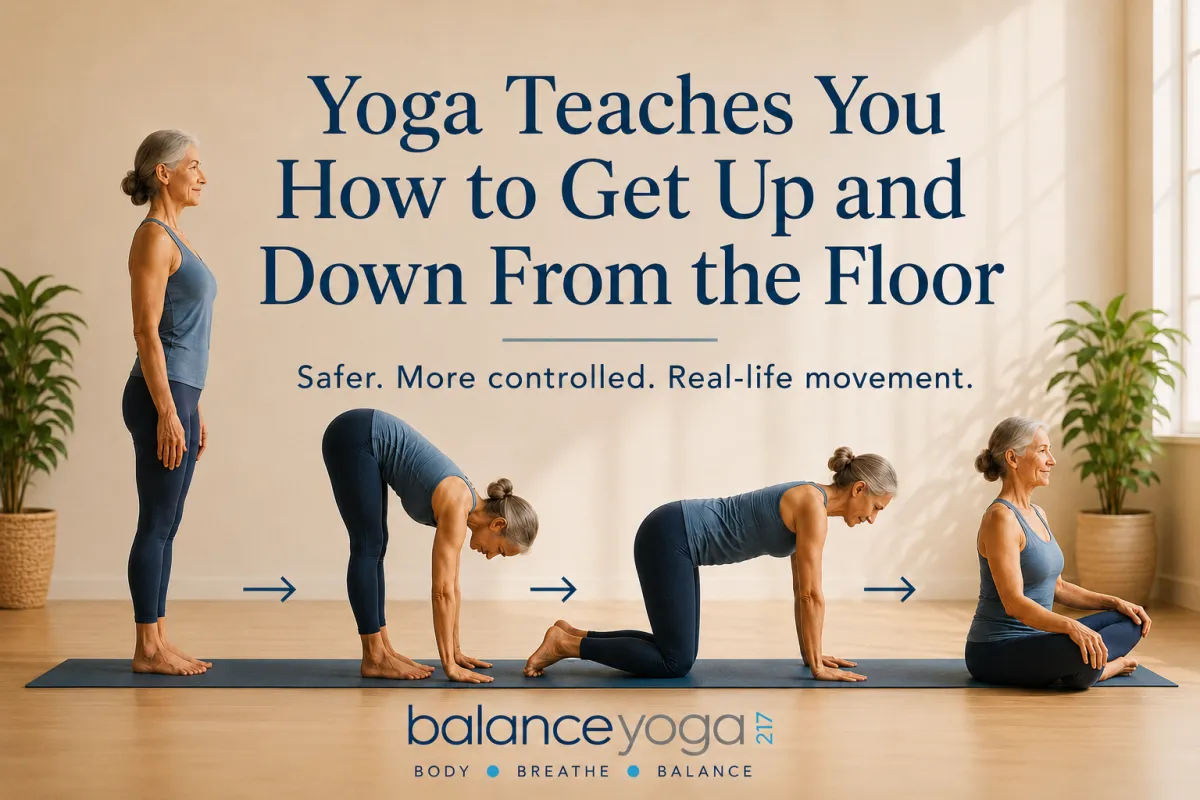
You might begin standing. Then you fold forward. Your hands come toward the floor or yoga blocks. You step your feet back. You move into Table or Downward Facing Dog. Your knees come down. Eventually you shift your hips and come into a seated or reclined position.
Then, later in class, you reverse the process.
You come back onto your hands and knees. Maybe you move through Down Dog. You walk your feet toward your hands or your hands toward your feet. You come into a forward fold. Then you rise back to standing.
We do it so often that we stop noticing what an incredible life skill we are actually practicing.
How Do You Normally Get Down on the Floor?
This became the funny part of class.
I showed my students what I sometimes do when I am NOT thinking about yoga.
I lean awkwardly toward one side.
I reach a hand toward the floor or furniture.
I hope my arm is strong enough to support me.
Then I sort of collapse or plop onto one hip.
Sound familiar?
A lot of us don't have an actual strategy for getting down to the floor. We just... get down there somehow.
And often the same thing happens when we need to stand back up.
We push.
We pull.
We use momentum.
We grab furniture.
We twist.
We brace.
We hold our breath.
Then we hope nothing breaks, gets strained and that everything cooperates.
Yoga Gives Us a Movement Strategy
Now compare that with the movement patterns we practice in yoga.
From standing:
Stand tall.
Fold forward.
Bring your hands toward the floor.
Step one foot back and then the other.
Come into Down Dog or Table.
Lower the knees.
Shift the hips until you are seated.
To come back up:
Move into Table or Down Dog.
Bring the feet and hands closer together.
Come into a forward fold.
Use the legs and hips to rise back to standing.
There are many variations, of course. Different bodies need different pathways.
The important part isn't memorizing one "correct" way to get down and up.
The important part is that yoga gives you options.
It teaches you how to organize your body instead of simply throwing yourself toward the floor and hoping for the best.
This Is What Functional Movement Looks Like
This is one of the reasons I get frustrated when yoga is reduced to stretching.
Yoga can teach us much more than how to stretch our hamstrings.
It teaches us to shift our weight.
It teaches us where our feet are.
It teaches us how to use our hands and arms for support.
It teaches us to bend our knees and hips.
It teaches us to move from standing to kneeling to sitting.
It teaches us to coordinate multiple parts of the body.
It teaches us to slow down enough to actually notice HOW we are moving.
And those are skills we use outside the yoga studio.
Getting something out of a low cabinet.
Playing with a grandchild.
Gardening.
Picking something up from the floor.
Sitting on the ground.
Getting back up again.
These movements matter.
The Goal Isn't a Perfect Down Dog
This is the kind of yoga I want my students to understand.
Yes, we practice poses.
But the pose is not necessarily the point.
What are you learning while you are in that pose?
Are you learning how to shift your weight?
Are you learning how to stabilize yourself?
Are you learning how to use your legs and hinge from your hips instead of depending entirely on your back?
Are you learning how your hands, feet, hips, spine, and breath work together?
And can you take those lessons outside the studio?
Because someday the accomplishment may not be doing a beautiful yoga pose.
It might be getting yourself down onto the floor and knowing you can get yourself back up again.
That is yoga too.


