Why Balance Gets Harder as We Age
Why Balance Gets Harder as We Age
And what you can do to support it
Have you ever noticed that balance doesn’t feel quite as automatic as it used to?
Maybe you wobble more when putting on your pants. Maybe standing on one foot feels harder than it once did. Maybe you feel steadier when you have a wall, chair, or countertop nearby.
If so, you’re not imagining it.
Balance often becomes more challenging as we age. But that doesn’t mean you’re doomed to lose it.
In fact, balance is something we can practice, improve, and support.
Balance Is More Than Standing on One Foot
When most people think about balance, they picture standing in Tree Pose or trying not to wobble.
But balance is happening all day long.
It helps you:
walk across a room
step off a curb
turn around quickly
climb stairs
reach for something overhead
get up from the floor
stay steady when you lose your footing
Balance isn’t just one skill. It’s the result of several systems in the body working together.
What Helps Us Balance?
Balance depends on input from three major systems:
1. Vision
Your eyes help you understand where you are in space and what’s happening around you.
2. Inner ear
Your vestibular system helps you sense motion, head position, and changes in direction.
3. Body awareness
Your muscles, joints, and nervous system give your brain information about where your body is and how it’s moving. This is called proprioception.
Your brain takes in all of that information and helps you make the tiny adjustments needed to stay upright.
It’s pretty amazing, really!
So Why Does Balance Get Harder?
There are a lot of reasons balance may become more challenging over time.
We move less
If you stop challenging your balance, your body stops practicing it.
Like strength, mobility, and coordination, balance is a “use it or lose it” skill.
We get stiffer
Limited ankle mobility, tight hips, or a less responsive spine can make it harder to adjust quickly when your body sways.
We lose strength
Leg strength, foot strength, and core support all play a role in balance.
Reaction time may slow
Sometimes it’s not that people can’t balance. It’s that they respond more slowly when balance is challenged.
Confidence changes
If you’ve had a fall, a close call, or simply feel unsteady, fear can make you move more cautiously and less naturally.
And the less confident you feel, the less likely you are to practice the very thing that would help.
Here’s the Good News
Balance can improve.
You do not have to accept feeling wobbly as an unavoidable part of aging.
Will balance look exactly the same at 75 as it did at 25? Maybe not.
But that doesn’t mean you can’t build steadiness, confidence, strength, and skill.
The body continues to learn throughout life.
A Simple Balance Experiment
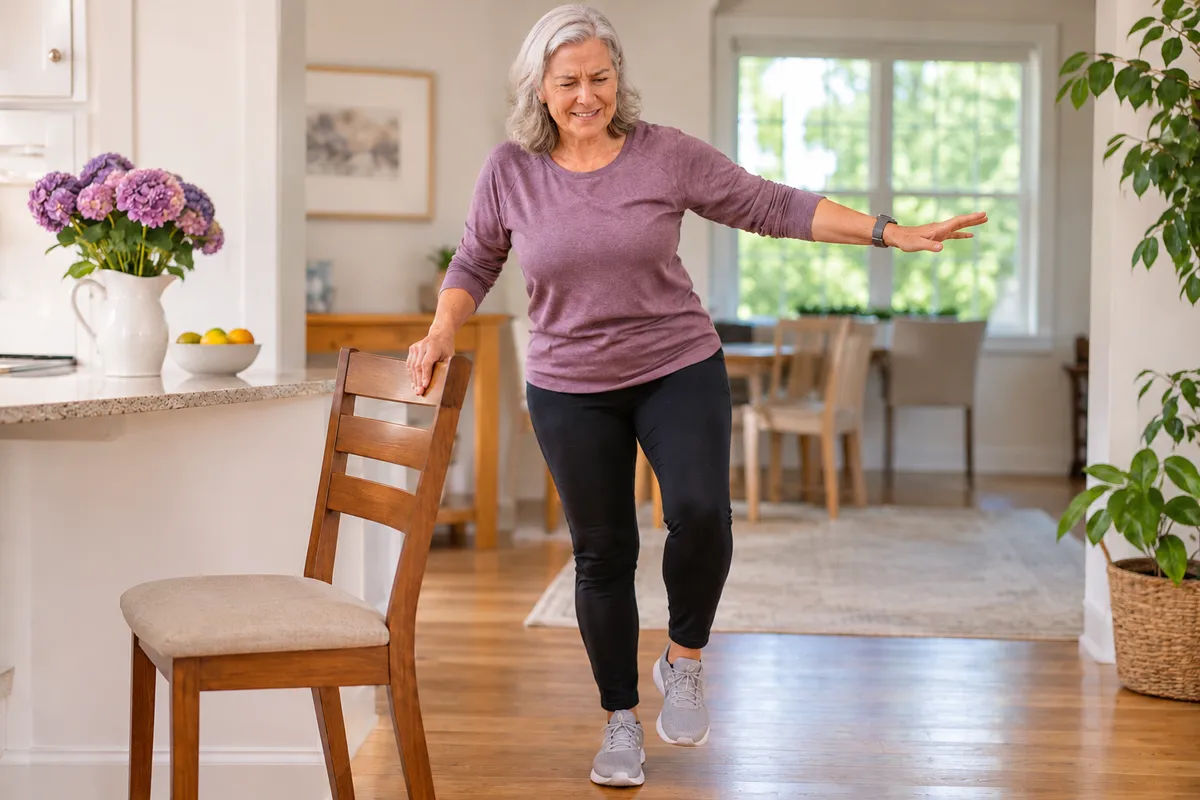
Try this near a wall, counter, or sturdy chair.
Stand with both feet on the floor.
Notice:
Where is your weight?
Do you lean more into one foot?
Are your toes gripping?
Are your knees locked?
Can you feel all four corners of each foot?
Now lightly shift your weight into one foot and lift the other heel.
Then maybe lift the whole foot just a little.
You don’t have to hold it for long.
You don’t have to make it fancy.
You’re simply giving your body a chance to practice.
That counts.
What Actually Helps?
Balance improves when we challenge it in safe, manageable ways.
That may include:
standing on one foot with support nearby
shifting weight from side to side
practicing heel-to-toe walking
strengthening feet and ankles
improving posture and body awareness
learning how to use your breath and attention to stay calm when you wobble
And yes — yoga can help.
Not because yoga magically fixes everything, but because it gives us opportunities to develop awareness, strength, mobility, and coordination in a thoughtful way.
At Balance Yoga, we often use props, chairs, the wall, and modifications to help students safely explore what their bodies can do.
Wobbling Is Not Failing
This may be my favorite reminder of all:
Wobbling does not mean you’re bad at balance.
Wobbling is information.
It means your body is responding, adjusting, learning, and practicing.
That’s part of the process.
In fact, if you never challenge your balance enough to wobble a little, you may not be giving your body much opportunity to improve.
Balance Is About More Than Falling
Yes, balance matters for fall prevention.
But it also matters for freedom.
It matters for confidence.
It matters for continuing to do the things that make daily life easier and more enjoyable.
Getting dressed. Walking outside. Going up stairs. Reaching, turning, stepping, and moving through the world with more ease.
That’s a big deal.
A Little Practice Goes a Long Way
You do not need an extreme program to support your balance.
You need consistent practice.
A few mindful moments here and there can make a real difference.
Stand on one foot while holding the kitchen counter.
Practice shifting your weight while brushing your teeth.
Notice how you use your feet when you stand in line.
Become curious.
Practice safely.
Keep going.
Because balance isn’t something you either have or lose forever.
Balance is a skill. And skills can be practiced.
— BIG Love —
Angie Ryan, E-RYT 500, YACEP
Owner & Educator, Balance Yoga Studio & School
Springfield, Illinois
Want help building strength, balance, and body awareness in a supportive environment? Join us at Balance Yoga.


